AAU, Developmental or FYBL: Which Path Fits Your Player?
Three team paths, three different commitments, and one question to ask before you pick.
October 8, 2026 · 4 min read
Once a player has some skills and a taste for competition, the next question for parents is usually which team to join. The Basketball Warehouse Academy runs three team paths, and the weekend drive is the smallest of the differences. Here's how they compare, drawn from the academy's own descriptions, so you can match the commitment to the player rather than the other way around.
What every team has in common
All teams at the academy require try-outs, regular practice and game participation. That's worth saying first because it sets the tone. These are real teams with expectations, not drop-in sessions. The coaches describe their role as teaching, encouraging and mentoring players at every step, helping them gain mastery of individual effort and teamwork. The academy also frames travel teams as a way to maximize a student-athlete's opportunity to reach goals in both basketball and education.
AAU: the Warehouse Ballers
The Warehouse Ballers are the competitive travel teams, playing under AAU, YBOA and USSSA. The Amateur Athletic Union is a non-profit sports organization dedicated to the promotion of athletics and fitness. Here's the shape of the season:
- Season: January through June, about six months.
- Tournaments: expect 6 to 8 weekend tournaments.
- Who plays: boys and girls teams, 4th to 11th grade.
- Practice: skills training and practices 2 to 3 days a week.
- Roster: about 9 to 10 players per team, to maximize playing time.
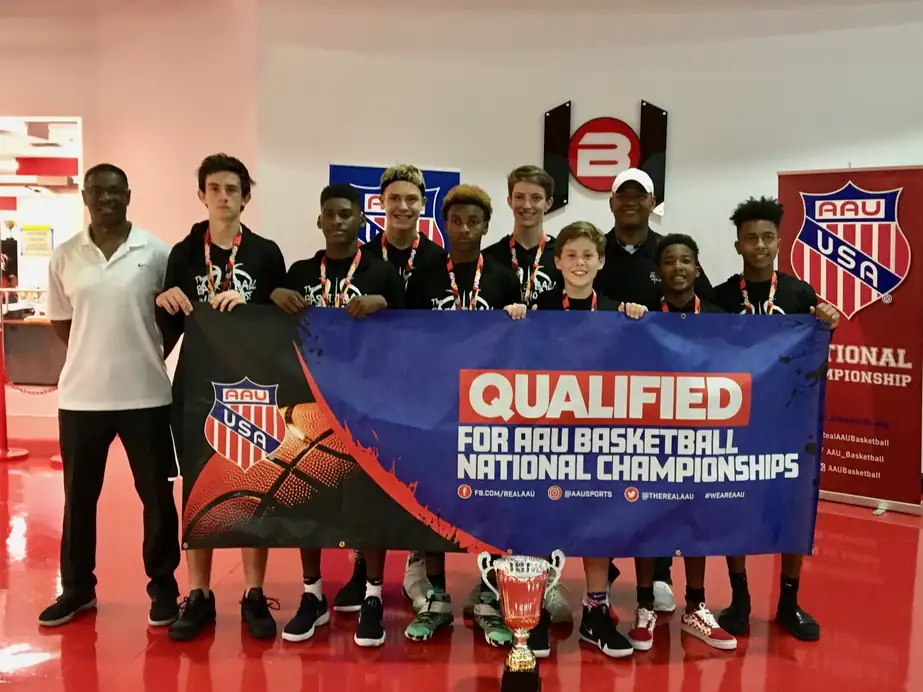
The number of teams depends on how many players sign up and at what skill level, and players may be moved up in age. The academy also notes that AAU can be a talent showcase, since players compete in local, regional or even national tournaments. One of the photos on the academy's wall shows an 8th grade team with the banner for its bid to the AAU National Championships, a reminder of where this path can lead.
This is the right fit for a player who loves to compete, can commit to a weekly practice rhythm, and whose family can handle a half-year of weekend travel.
Developmental teams: competitive without the travel
Developmental teams follow the same structure as the travel teams, with one big difference: no weekend tournaments. The goal is to develop players who aren't yet ready for the high-level competitive teams and get them ready for future seasons.
- Practice 2 to 3 days a week and take part in all skills work.
- Play organized internal scrimmages, plus scrimmages with other similar programs.
- May enter a small venue D-2 tournament if enough progress is made, paid for separately.
- Encouraged to add private lessons to develop faster.
The academy says developmental teams are for players who don't want to travel or spend the extra cost, but still want all the coaching, practice time with a team and experience that makes them better for a future team. For many families that's an honest and smart choice, especially for a player who's newer to team play or whose schedule is already full. It's also a path with a door: the academy notes developmental members can serve as call-ups for the travel squads when conflicts or injuries come up, depending on interest and availability.
FYBL: the middle school league
FYBL stands for Florida Youth Basketball League. The academy lists FYBL affiliate teams working with Nike Team Florida at the 12u (6th grade), 13u (7th grade) and 14u (8th grade) levels. The league follows the model of Nike's Elite Youth Basketball League and offers a season-long competitive environment, with league play, player and coaching clinics, and a championship tournament at the end of the season.
The league has 24 teams in three divisions of eight, covering 6th to 8th grade. If your middle schooler wants a structured season with a schedule, standings and a finish line instead of a string of one-off tournaments, this is the path to ask about.
Questions to ask before you pick
The labels matter less than the match. Before you decide, sit down with your player and work through a few honest questions.
- Does your player want to travel, or does your player want to get better and play?
- Can your family cover practices 2 to 3 days a week, plus weekend tournaments if you pick AAU?
- Is your player ready for high-level competition now, or building toward it?
- How does your player handle losing? A tournament weekend has more of it than a practice does.
Listen to the answers your player gives, not the ones you'd like to hear. A player pushed into a schedule they don't want can burn out by March, and one held back when ready can lose interest for a different reason.
How try-outs work for new families
Because every team requires a try-out, treat it as a conversation instead of a verdict. In general, coaches at any try-out notice effort and coachability. Showing up on time, listening, hustling on defense and encouraging teammates says more than any one highlight.
If your player doesn't land where you hoped, ask what to work on. A season of developmental practice and private lessons is a common way to build toward a future team.
A quick note on timing
Because the travel season runs January through June, the time to ask questions is well before the new year. Call early, find out when try-outs are, and give your player a few months of focused training first. Showing up prepared makes the first practice feel like a continuation instead of a test.
To compare the teams side by side, see /travel-teams, or call Coach Allen at (727) 235-4726 to ask about try-outs and which team fits your player.
The Basketball Warehouse Academy, (727) 235-4726
Call (727) 235-4726More articles
Private Lessons or Group Training? How to Choose for Your Player
The two formats solve different problems, and most players eventually benefit from both.
What a Week of Youth Basketball Day Camp Looks Like
From the first morning to Friday afternoon, here's what to expect and what to put in the bag.