Why the 1500 Club Worked: Volume, Repetition, No Shortcuts
A number on a wall shows what real shooting practice looks like, and how any player can borrow the idea.
October 8, 2026 · 4 min read
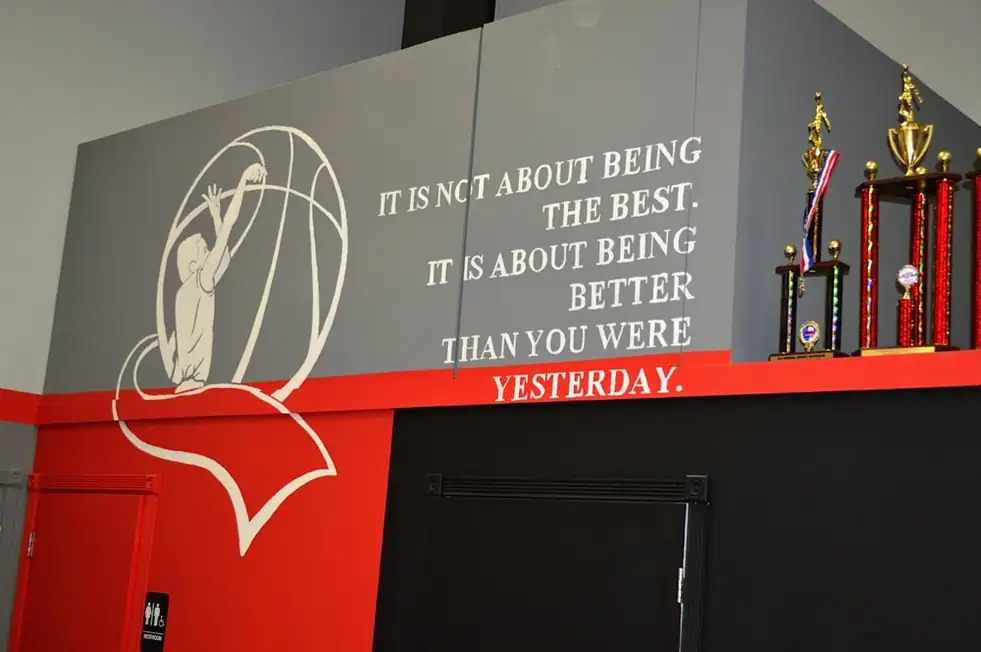
In the early years of The Basketball Warehouse Academy, there was a club on the wall for any player who made 1,500 three-point baskets in a week. It was called the 1500 Club. The number sounds almost silly the first time you hear it. Then you do the math, and the idea underneath it starts to make sense, and it's one any family can use without a single trophy involved.
Doing the math
Fifteen hundred makes in seven days works out to roughly 215 made threes a day, every day. If you took off one day, it's 250. And that counts makes, not shots. A player hitting a respectable percentage might need to put up well over twice that many attempts to reach the number.
Nobody gets there by casually shooting around after dinner. You get there by showing up every day with a plan, and by having a way to take a lot of shots quickly. That's where the equipment mattered. The academy's shooting machines return the ball fast, so a shooter spends time shooting instead of chasing rebounds. A 2012 article on the academy's site credits a shooting gun as a key factor in one young player's quick development.
That same article reports that the youngest player to make the club at the time was a 7th grader. The details don't matter as much as the pattern: a kid who arrived without much basketball background got better because he showed up, shot a great many times, and kept going.
Why volume works
Shooting is a motor skill. Your body learns it through repetition, the same way it learns a golf swing or a piano scale. The first few hundred shots are clumsy. Somewhere in the thousands the motion gets quieter: the feet set the same way, the ball leaves the hand on the same arc, and the player stops thinking about mechanics and starts reading the defense.
Volume also builds something harder to measure. Players who've hit hundreds of shots in a session don't panic at the line in the fourth quarter, because they've been there already. They're not hoping the ball goes in. They know what the ball does when their form is right.
But only the right reps count
Here's where the club's idea gets sharper. The academy's training page says there are no shortcuts. To be great, you must practice. Not just practice: you must practice only the right way, every time. Volume with sloppy form is just a way to practice sloppy form faster.
That's the argument for pairing big numbers with a coach. A coach spots the thumb that flicks the ball sideways, or the hips that lean back on every miss, and corrects it before it becomes a habit. The academy's private lessons exist for exactly this reason, and the shooting machine is a great tool once the form is worth repeating.
How to borrow the idea at home
You don't need a club, a wall or 1,500 shots. You need the principle. Here's how to scale it to a player's age and level:
- Pick a number your player can hit every week without dreading it, then count makes, not just time spent.
- Shoot from spots, not at random. Five spots, ten makes each, then move.
- Write the total down. A simple notebook turns effort into proof and shows progress that's hard to feel day to day.
- Stop a session on a good rep, not a tired one. Form that falls apart late teaches the wrong motion.
- Raise the number slowly, a little at a time, as it gets easy.
Younger players should lean on shorter distances and form first, with the range growing as they get stronger. If your player complains of sore arms or shoulders, back off the volume and ask a coach about the right workload. More isn't better if the body can't keep up.
What the number really measures
In the end, the 1500 Club wasn't about threes. It was a public, visible way of saying that consistency counts. It honored any player who put in the work to hit the number, whatever natural ability they started with. That fits the line painted on the Warehouse wall: it is not about being the best, it is about being better than you were yesterday.
That's a healthier measuring stick for kids than comparing themselves to the best player in the gym. A player who tracks makes can see the number grow, and a growing number is motivation you can't fake. Parents can help by noticing effort out loud: the extra set, the practice on a rainy day, the shot taken again when the first form was off.
A season-long habit
The best shooters are usually the ones who built a routine early and kept it. Make the routine small enough to survive a busy school week: twenty minutes, a notebook, a clear target. Add a lesson or group session when you want a coach's eye on the form. Then keep going until the shots feel boring, because boring is what good looks like.
To talk about building a shooting routine with a coach, see /individual-group-training or call Coach Allen at (727) 235-4726.
The Basketball Warehouse Academy, (727) 235-4726
Call (727) 235-4726More articles
Private Lessons or Group Training? How to Choose for Your Player
The two formats solve different problems, and most players eventually benefit from both.
What a Week of Youth Basketball Day Camp Looks Like
From the first morning to Friday afternoon, here's what to expect and what to put in the bag.